In a country as diverse as India, where over 1.4 billion people communicate in a myriad of languages and dialects, the demand for robust speech recognition systems is unprecedented. Enter Saaras V3, a revolutionary upgrade in the field of Automatic Speech Recognition (ASR) that promises to transform how we interact with technology in our native tongues. With support for 22 official Indian languages and English, Saaras V3 is the epitome of cutting-edge multilingual and streaming ASR technology.

The Technological Leap: From Saaras V2.5 to V3
Saaras V3 builds on the solid foundation laid by its predecessor, Saaras V2.5, which had already set a new benchmark by achieving a ~22% Word Error Rate (WER) on the IndicVoices benchmark. The new version brings this number down to ~19%, a significant improvement that highlights its superior performance in multilingual contexts.
According to Digit.in, Saaras V3 is trained on over 1 million hours of audio data, allowing it to handle 'Hinglish'—a blend of Hindi and English—more effectively than ever before. This massive dataset is crucial in capturing the linguistic nuances and variability present in everyday Indian speech.
Redefining Real-Time Transcription
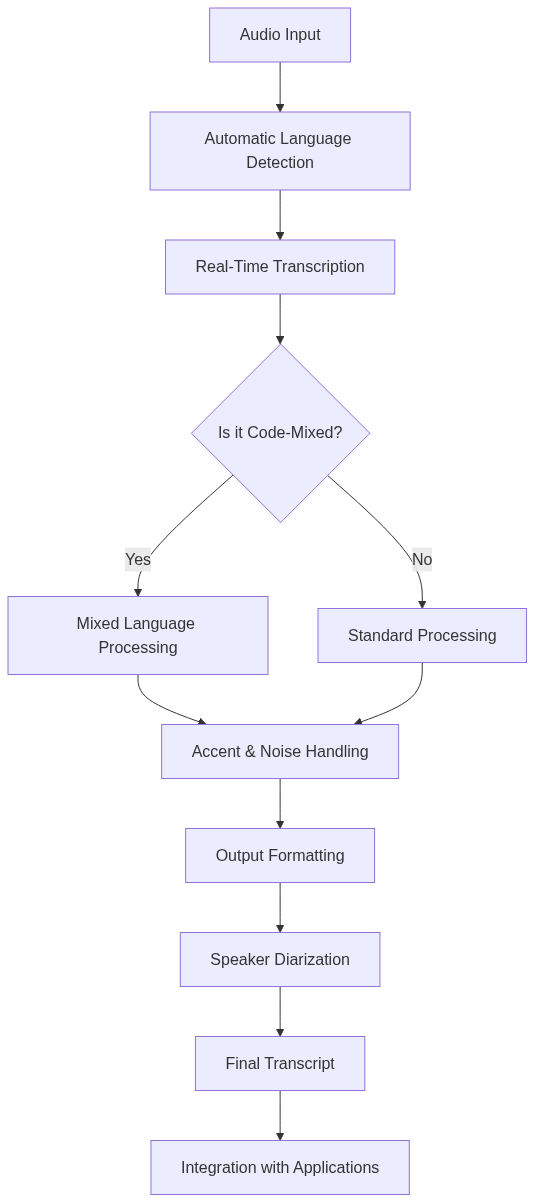
One of the standout features of Saaras V3 is its real-time transcription capability. Unlike traditional batch-oriented models that wait for the completion of speech to deliver a transcript, Saaras V3 processes speech incrementally, reducing the time to first token and allowing for a more natural flow of text.
This feature is particularly beneficial in applications such as live captions, gaming interactions, and call-center tools, where real-time feedback is crucial.
According to Gnani.ai, the ability to perform real-time transcription with low latency is a key enabler of digital transformation in multilingual markets like India.

Robust in Real-World Conditions
Speech recognition systems must thrive in the real world, where speech is not always clear or structured. Saaras V3 is designed to handle the complexities of code-mixed speech, varying accents, and background noise with ease. Its robust architecture ensures stable performance even in noisy environments, making it ideal for diverse settings such as agriculture and clinical applications.
Emergent Mind's ASRU MADASR 2.0 Challenge highlights the diversity of Indian languages and dialects, underscoring the importance of systems like Saaras V3 that can accurately process this complexity.
Meeting the Needs of a Multilingual Nation
India's linguistic landscape is vast and varied, with millions of speakers across multiple dialects and languages. Saaras V3 addresses this diversity by offering support for 23 languages, making it a versatile tool for enterprises looking to engage with a broader audience.
Reverie Inc. notes the growing trend towards developing multilingual ASR systems that can handle code-switching and localization, a trend that Saaras V3 is at the forefront of. This capability is not just about transcription accuracy but also about enabling meaningful interactions in native languages.
Applications Beyond Transcription
Saaras V3 is more than just a transcription tool; it offers structured audio understanding features that integrate seamlessly into downstream workflows. Features like automatic language detection, output format control, and speaker diarization make it a comprehensive solution for a variety of applications, from meeting summaries to conversational AI orchestration.
These capabilities are essential for sectors like customer support and quality assurance, where understanding who said what is as important as the content itself. The ability to deliver structured, reliable outputs makes Saaras V3 indispensable in modern, dynamic environments.
Conclusion
As we continue to witness rapid advancements in speech recognition technology, Saaras V3 stands out as a leader in the field, especially within the challenging multilingual context of India. Its ability to deliver high accuracy, real-time processing, and structured outputs makes it a powerful tool for enterprises looking to harness the potential of voice technology. Jina Code Systems is well-positioned to help organizations implement and scale such innovations, enabling them to operate smarter and innovate continuously in a digital-first world.