In the world of artificial intelligence, simplicity often holds the key to innovation. The recent release of MicroGPT by Andrej Karpathy exemplifies this notion by offering a minimalistic approach to training and inferring GPT models in pure Python.
In an industry where complexity is often the norm, MicroGPT stands out by stripping down the essentials to their most basic form. This blog delves into how MicroGPT is shaping AI development and what it means for developers and tech leaders.

The Essence of MicroGPT
MicroGPT is a compact implementation of a GPT model, designed to demonstrate the core principles of transformer architectures without the added weight of dependencies. At just 180 lines of code, it provides a clear and concise entry point for understanding the mechanics of GPT models.
What makes MicroGPT revolutionary is its ability to encapsulate the fundamental algorithms of GPT in a way that's accessible and educational. This is particularly beneficial for developers who want to grasp the intricacies of AI without getting bogged down in complexity.
- Minimalist design: Focuses on core functionalities.
- Educational value: Ideal for learning and teaching AI principles.
- Open-source: Encourages community collaboration and innovation.
This is great, very clear and easy to read — AvikantSrivastava

Real-World Applications and Implications
While MicroGPT is a simplified version, its implications for real-world applications are significant. According to Microsoft, over 1,000 organizations have leveraged AI to transform their operations, highlighting the demand for scalable and efficient AI solutions.
MicroGPT's minimalist approach can serve as a foundation for developing more complex models tailored to specific industry needs. This aligns with the trend towards agentic AI, where autonomous agents perform tasks, enhancing productivity across sectors.
- Scalability: Provides a base for custom solutions.
- Efficiency: Reduces resource consumption with streamlined code.
- Innovation: Spurs new AI applications by simplifying initial development stages.
AI technologies are expected to drive significant productivity gains across various sectors by 2025 — McKinsey

Technical Breakdown: How MicroGPT Works
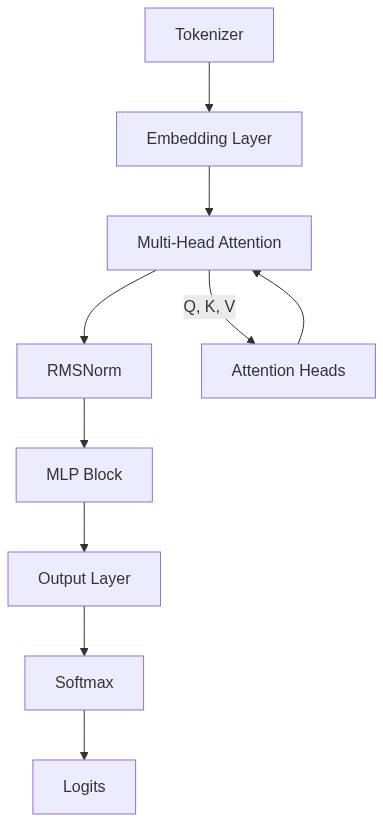
MicroGPT's architecture is a testament to the power of simplicity. It utilizes a single-layer transformer with a focus on core components like token embedding, position embedding, and multi-head attention. The model employs RMSNorm instead of LayerNorm, and ReLU activation instead of GeLU, reflecting its streamlined design.
Key technical components include:
- Embedding Dimensions: Set to 16, balancing complexity and performance.
- Attention Heads: Four attention heads to capture diverse aspects of data.
- Block Size: A maximum sequence length of 16 tokens, optimizing processing time.
By focusing on these elements, MicroGPT provides a foundational understanding of how larger, more complex GPT models operate.
Challenges and Limitations
Despite its advantages, MicroGPT is not without limitations. As noted by industry analyst Derek Megyesi, one of the key challenges is the inability to handle real-time data and platform-specific nuances, which are critical for many AI applications.
Furthermore, while MicroGPT is excellent for educational purposes, its minimalistic design may not be sufficient for production-level implementations without significant modifications and enhancements.
Despite advancements, there are challenges and limitations associated with AI models like GPT-5 — Derek Megyesi
MicroGPT and the Future of AI Development
MicroGPT represents a shift towards more accessible AI tools that lower the barrier to entry for developers and organizations. By simplifying the complex, it encourages experimentation and innovation within AI development.
As AI continues to evolve, tools like MicroGPT will play a crucial role in democratizing technology, enabling more people to contribute to advancements in AI. This aligns with Jina Code Systems' mission to design, build, and scale intelligent digital systems, offering businesses the tools they need to innovate continuously.
- Empowerment: Supports emerging developers in understanding AI concepts.
- Innovation: Fosters an environment conducive to creative AI solutions.
- Accessibility: Makes AI development more approachable for organizations of all sizes.
Conclusion
As AI technology advances, the simplicity embodied by MicroGPT will be instrumental in shaping the future of AI development. It provides a clear path for understanding and innovating within the AI space, making complex technologies accessible to a broader audience.
For organizations looking to harness the potential of AI, partnering with experts like Jina Code Systems can provide the guidance and technical expertise needed to adopt and scale intelligent digital solutions effectively.