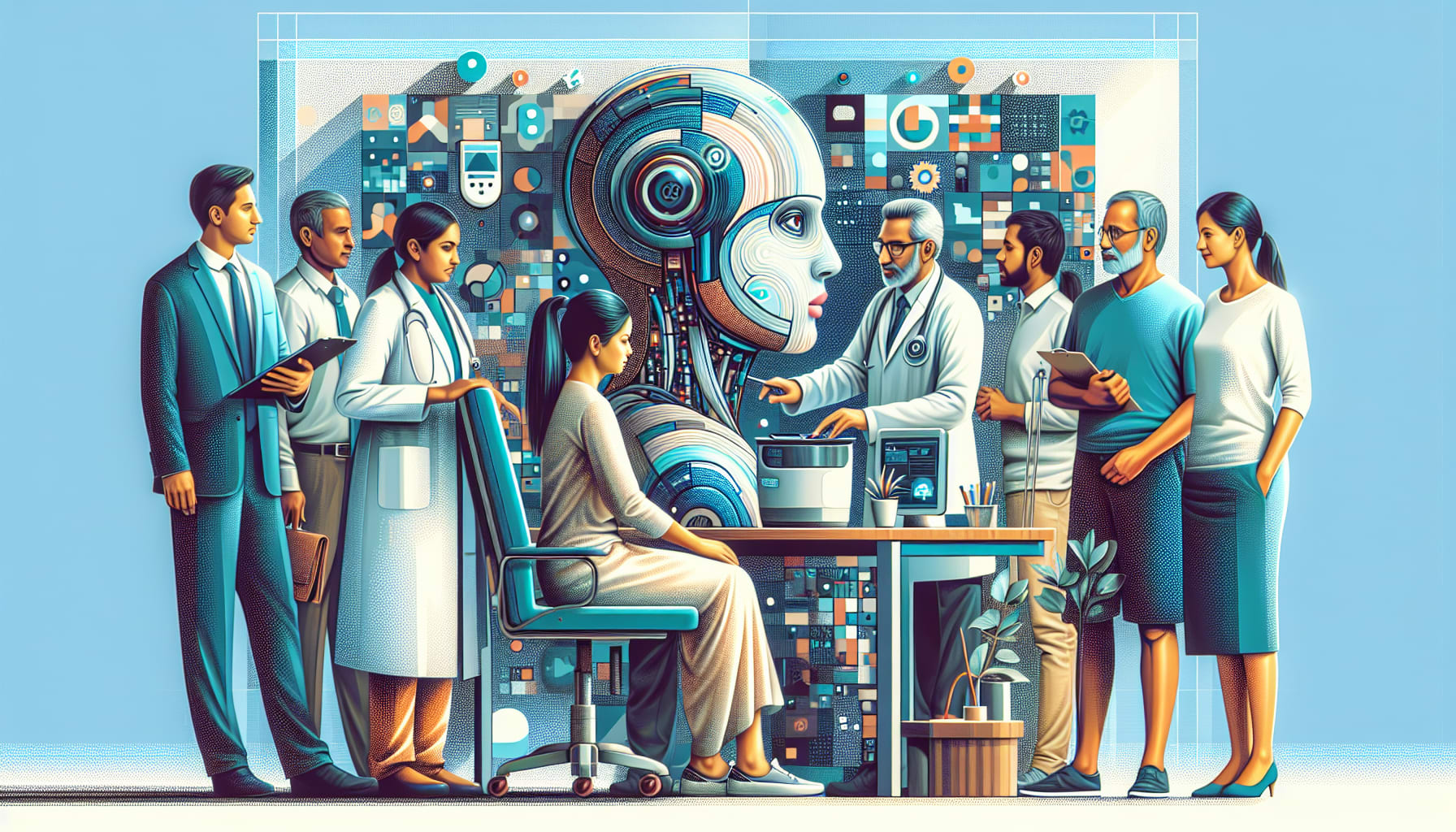
India’s clinics are a stress test for global AI. In the cacophonous corridors of Mumbai hospitals, a doctor’s attention darts from patients to colleagues to paperwork—while an AI scribe tries (and often fails) to keep up. Ambient AI, lauded as the future of healthcare documentation in the West, is being put to the ultimate challenge in India’s multilingual, interruption-heavy clinical settings. But as we’ll see, the problem isn’t just technical—it’s cultural, infrastructural, and deeply human.
Ambient AI Meets Indian Reality: Why Context Is Everything
The promise of ambient AI—systems that passively capture and transcribe conversations without prompts—has already reshaped doctor-patient interactions in the US and Europe. According to Gartner’s 2024 healthcare technology outlook, over 60% of large US hospitals have piloted or implemented AI-based voice documentation tools.
But transplant those same tools into an Indian clinic, and the cracks show immediately. Consider a patient saying, “I have sugar,”—a common way to describe diabetes in India. For an imported AI scribe, the phrase is meaningless. Add in overlapping voices, background chatter, and frequent code-switching between Hindi, English, and regional dialects, and the task becomes even tougher. As The Ken reports, even the best international tools falter under these conditions.
This isn’t just a minor inconvenience. The lack of contextual awareness and adaptability can lead to transcription errors, clinician frustration, and ultimately, risks to patient care. The lesson? AI must be engineered with local context in mind, not just ported across borders.
The EHR Bottleneck: Why Tech Infrastructure Shapes AI’s Fate
Even before AI can tackle language and noise, it faces a more fundamental hurdle: fragmented digital infrastructure. In the US, widespread adoption of electronic health records (EHRs) provides a backbone for integrating AI scribes. But in India, most hospitals—especially in the public sector—still rely on handwritten notes and paper files.
Ganesh Gopalan of Gnani, a Bangalore-based voice-AI startup, points out that where EHRs do exist in India, they’re often proprietary and non-standardized. Integration becomes a custom engineering challenge, not a plug-and-play affair. A 2023 NASSCOM report found that only less than 20% of Indian hospitals have any form of digital health record system, compared to over 95% in the US.
This lack of standardization means that AI solutions must be painstakingly tailored for each hospital’s unique workflow and IT landscape. It’s no surprise that local startups like Dawnbreak and Eka Care are focusing as much on integration engineering as on AI model training. Their progress highlights a critical insight: AI in healthcare is as much an infrastructure challenge as it is an algorithmic one.

Multilingual Chaos: Engineering AI for India’s Consultation Rooms
So, what exactly makes Indian clinics so tough for AI? The answer lies in the unique linguistic and behavioral patterns found in day-to-day consultations. Doctors juggle multiple conversations, patients switch between languages mid-sentence, and interruptions are the norm. For instance, a junior doctor might interject with a test result while a patient describes symptoms in a mix of Marathi and English.
Building robust AI systems for such environments means going beyond traditional speech-to-text. Solutions must:
- Detect and separate overlapping voices
- Interpret regional idioms and medical slang
- Handle code-switching and dialect shifts
- Filter out irrelevant background noise
Startups like Dawnbreak AI and Eka Care are using homegrown datasets and context-aware models to tackle these issues. According to Dawnbreak’s founder Pranav Karthik Nagesh, their systems are trained on thousands of hours of Indian clinical audio—an approach simply not feasible for global vendors unfamiliar with local nuances. This isn’t just a technical detail; it’s a competitive moat.
AI Scribes and the Battle Against Burnout
Despite their imperfections, AI scribes are winning converts among Indian doctors. Why? The answer lies in the unrelenting workload. According to a 2024 study by the National Library of Medicine, Indian physicians spend up to 30% of their workday on documentation—often after hours, a phenomenon dubbed “pajama time.” Burnout is a real and growing risk.
In India, doctors handle up to 100 patients a day, compared to 20-30 in many Western countries. — NASSCOM, 2023
Ambient AI, even when only partly accurate, can slash this after-hours admin time, freeing clinicians to focus on care and personal well-being. As AI scribes improve, they promise not just efficiency, but a meaningful reduction in burnout—an outcome with real implications for public health and hospital economics.
The Next Frontier: Predictive Health and Diagnostic AI—But Only if the Basics Work
The long-term vision for AI in healthcare goes beyond transcription. Imagine predictive health models that flag at-risk patients in real time, or diagnostic AI that supports clinical decision-making at the point of care. This is already happening in pockets—Apollo Hospitals, for example, has piloted AI-driven risk stratification for heart disease and diabetes (Apollo Hospitals AI announcement).
But the lesson from India’s clinics is clear: predictive and diagnostic AI can only succeed if the foundational layers—accurate, context-aware data capture and seamless integration—are in place. Otherwise, the AI revolution risks stalling at the starting line.
That’s why at Jina Code Systems, our approach to AI engineering always begins with the messy realities on the ground. We work with partners to build resilient, multilingual, and interoperable AI agents and automation platforms that fit local workflows—not the other way around. Visit our blog for deeper dives into real-world digital transformation challenges.
Conclusion
The story of ambient AI in India isn’t about failure—it’s about adaptation. Engineering AI for real-world impact means embracing local complexity, not wishing it away. As Indian innovators are showing, the future belongs to those who build with context, not just code. For healthcare leaders and developers facing similar challenges worldwide, the lesson is clear: AI’s value is only as strong as its fit with the people and systems it serves.
At Jina Code Systems, we help organizations design, implement, and scale intelligent digital solutions that work for their unique contexts—whether that’s a bustling Mumbai clinic or a global enterprise. Are you ready to bridge the gap between AI promise and practical reality?