In the dynamic landscape of scientific research, AI is not just a tool but a transformative collaborator. Gemini Deep Think by Google DeepMind exemplifies this shift, breaking barriers across diverse scientific domains. As we delve into the capabilities of AI in research, the implications for the future are profound and wide-reaching.
Crossing Mathematical Borders with AI
AI's ability to transcend traditional boundaries is exemplified by its impact on classic computer science problems. Take, for instance, the progress on 'Max-Cut' and the 'Steiner Tree' problems. Traditionally, these puzzles stumped researchers due to their complexity. However, Gemini Deep Think leveraged insights from unrelated mathematical branches to provide groundbreaking solutions.
- Max-Cut: Efficiently splitting networks.
- Steiner Tree: Connecting high-dimensional points.
According to the AI Index Report by Stanford HAI, AI applications in mathematical problem-solving are advancing rapidly, highlighting a transformative impact across scientific research.
Revolutionizing Optimization and Economic Theories
Optimization in machine learning has always required manual tuning of parameters. However, with AI's intervention, these processes are becoming more autonomous. Gemini introduced an automatic 'adaptive penalty' mechanism, enhancing efficiency and reducing human error. Similarly, economic theories, like those involved in auctioning AI tokens, are being extended to real-world applications through sophisticated AI techniques.
- Machine Learning: Automatic penalty adjustments.
- Economic Theories: Extending auction dynamics to continuous real numbers.
Thomas H. Davenport notes in the MIT Sloan Management Review that AI's role in evolving data science trends is crucial for future advancements.

AI's Role as a Scientific Force Multiplier
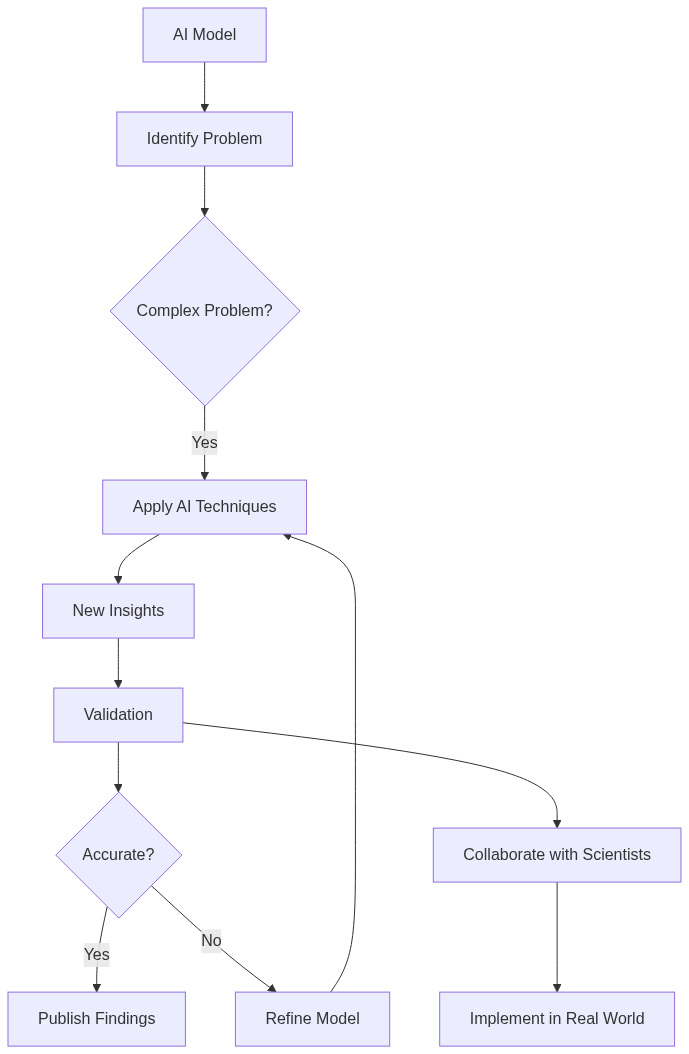
AI is becoming an indispensable partner in scientific research, acting as a 'force multiplier' for human intellect. By automating knowledge retrieval and verification, scientists can focus on conceptual depth. This collaboration is not only refining existing theories but also uncovering new ones.
For example, in the realm of physics, AI has facilitated novel solutions for calculating gravitational radiation from cosmic strings, using advanced mathematical constructs like Gegenbauer polynomials.
- Physics: Simplifying complex integral solutions.
- Mathematics: Offering new proofs and counterexamples.
According to Gartner, 65% of CMOs believe AI will dramatically change their roles in the next two years, signaling a similar shift in research methodologies.
Real-World Implications and Industry Applications
The implications of AI in research extend beyond academia into practical applications. Axiom, an AI-driven math startup, has solved several unsolved math problems, showcasing AI's potential in enhancing reasoning capabilities. The integration of AI in more complex problem-solving scenarios is becoming a trend across industries.
For developers and tech leaders, the application of AI in fields like cryptography, mechanism design, and information theory opens up new avenues for innovation and efficiency.
- Cryptography: Enhanced security protocols.
- Mechanism Design: Optimized economic models.
The AI Index Report highlights significant growth in AI applications, emphasizing its transformative impact across sectors.
Conclusion
As we look towards the future, AI's role in scientific research is set to expand even further. The collaboration between human intellect and AI is leading to unprecedented advancements. At Jina Code Systems, we recognize the value of AI agents and automation platforms in driving continuous innovation. As organizations seek to adopt these technologies, partnering with experts becomes crucial to harnessing their full potential.