The advent of AI agents in enterprise technology promises a paradigm shift in how businesses operate. As these agents take on increasingly complex tasks, understanding their autonomy becomes crucial. Recent studies, including those on Claude Code, reveal insights into how these agents are being deployed and managed in real-world scenarios.

The Reality of AI Autonomy in Practice
AI agents like Claude Code are designed to operate autonomously, yet their true potential is often underutilized. Studies show that while the capability of AI agents has significantly improved, the autonomy granted to them in practice lags behind. According to research, the 99.9th percentile turn duration for Claude Code nearly doubled from 25 minutes to over 45 minutes within a few months, indicating a slow but steady increase in the trust users place in these systems.
By 2026, only 20% of organizations have AI agents running in their production environments, while over 60% use some form of AI co-pilot. — LinkedIn
This disparity between capability and deployment underscores the need for effective oversight mechanisms. Jina Code Systems emphasizes the importance of developing robust monitoring infrastructures to bridge this gap, ensuring that AI agents can operate effectively and safely.
Understanding Human-Agent Interaction Dynamics
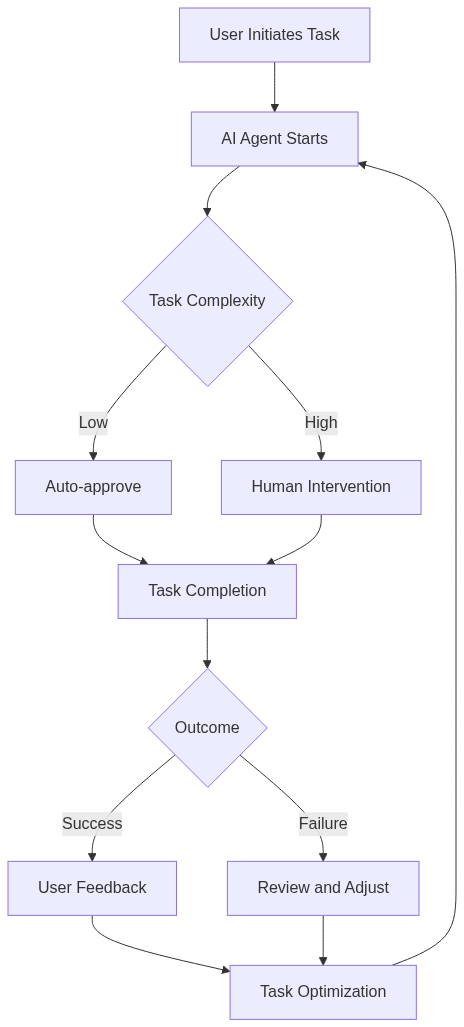
As users gain experience with AI agents, their interaction patterns evolve. Experienced users of Claude Code, for instance, tend to grant more autonomy by using auto-approve features more frequently, yet they also interrupt the agent more often when necessary. This suggests a shift towards a more supervisory role where users intervene only when needed.
- Auto-approval: Increased from 20% to over 40% as users gain experience
- Interruptions: Rise from 5% to 9% as users become more familiar with the system
Effective oversight doesn’t require approving every action but being in a position to intervene when it matters. — Anthropic Research
This shift highlights the importance of designing AI systems that facilitate seamless human oversight, a principle that Jina Code Systems integrates into its AI solutions. By focusing on user-centered design, we help enterprises harness AI agents' capabilities while maintaining control and safety.
Navigating Risks in High-Stakes Domains
AI agents are increasingly deployed in risky domains such as healthcare, finance, and cybersecurity. While most agent actions are low-risk, the potential consequences of errors in high-stakes areas necessitate careful risk management. According to a LinkedIn study, the cybersecurity market for AI agents saw $1.45 billion in venture capital spending, reflecting the growing need for secure AI implementations.
Jina Code Systems addresses these challenges by implementing advanced security protocols and compliance measures. Our AI-driven solutions are designed to operate safely in sensitive domains, ensuring that businesses can leverage AI without compromising on security.
Security concerns are becoming more prominent as AI agents take over, with a focus on securing AI usage and the AI agent product lifecycle. — Yahoo Finance
Through cutting-edge AI architectures, we help organizations mitigate risks while maximizing the benefits of AI deployment.

The Path Forward for AI Agent Adoption
As AI agents become more prevalent, the focus will shift from capability enhancements to the development of comprehensive oversight and risk management frameworks. This transition is essential for realizing the transformative potential of AI in industries beyond software engineering.
Jina Code Systems is at the forefront of this evolution, offering AI solutions that balance autonomy with oversight. By integrating real-time monitoring and feedback mechanisms, our systems empower enterprises to implement AI agents confidently and responsibly.
- Post-deployment monitoring: Essential for understanding real-world agent behavior
- Training models for uncertainty recognition: Complements external safeguards
Model developers should consider training models to recognize their own uncertainty and surface issues to humans proactively. — Anthropic Research
Our commitment to innovation ensures that businesses can navigate the complexities of AI deployment, harnessing the full potential of these technologies to drive growth and efficiency.
Conclusion
In conclusion, the journey of integrating AI agents into enterprise environments is just beginning. Organizations must prioritize developing robust oversight and risk management strategies to ensure these agents can operate safely and effectively. Jina Code Systems stands ready to support businesses in this transition, offering state-of-the-art AI solutions that empower enterprises to innovate while maintaining control and security.