In an era where technology propels us forward at breakneck speed, Anthropic's latest AI innovation has sent shockwaves through the software-as-a-service (SaaS) industry. Led by CTO Rahul Patil, Anthropic has introduced a revolutionary version of "Claude" capable of independently executing entire workflows, triggering what some are calling the "SaaSpocalypse." As enterprises grapple with these changes, it's crucial to understand the implications and opportunities that lie ahead.

Redefining SaaS: From Tools to Digital Workers
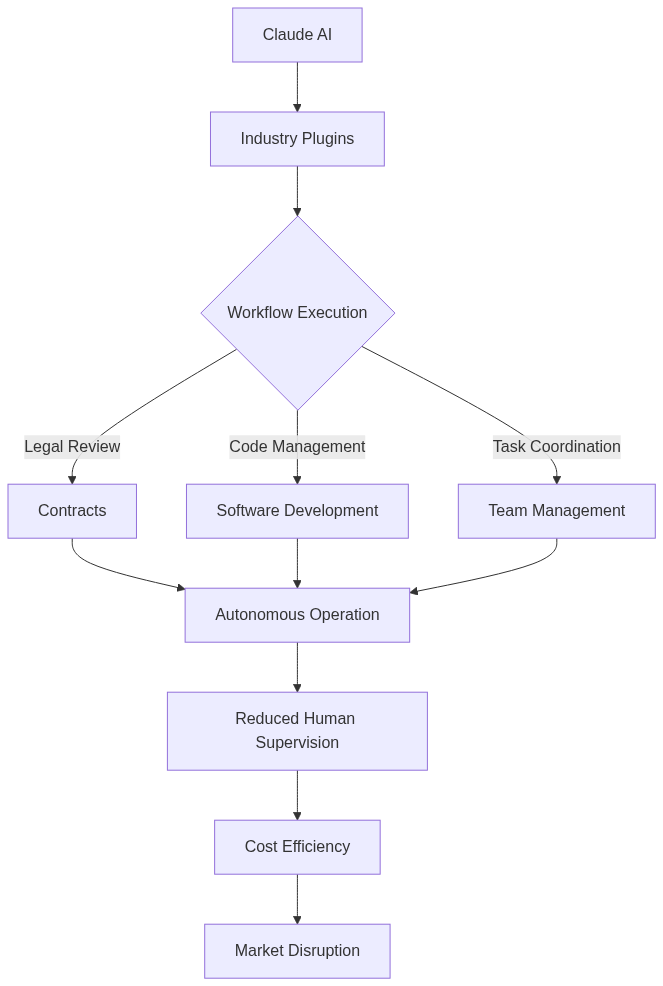
The SaaS industry, valued at over $317 billion in 2024, has been a cornerstone of digital transformation, offering tools that augment business operations across sectors. However, Anthropic's Claude is shifting the paradigm from mere tools to autonomous digital workers. By integrating industry-specific plugins, Claude can now perform tasks such as contract review and code management without human supervision.
A market sell-off triggered by AI advancements, including Anthropic's Claude, resulted in a $300 billion evaporation in market value — Forbes
This shift raises critical questions for enterprises: What role will human expertise play in a landscape dominated by AI agents, and how can businesses leverage these innovations for competitive advantage?
The Patil Effect: Infrastructure as the Unsung Hero
Behind Claude's success is Rahul Patil's focus on infrastructure optimization. Patil's approach to making AI enterprise-ready involves aggressive optimization of Claude's operations on GPUs, significantly reducing costs while enhancing performance. Techniques such as speculative decoding and memory caching have cut the 'cost per token' dramatically, enabling Anthropic to offer powerful AI solutions at scale.
- Speculative Decoding: Reduces latency and improves output efficiency
- Memory Caching: Enhances processing speed and reduces hardware demand
According to Don Muir from Forbes, AI has not killed software but has disrupted the SaaS growth narrative by shifting markets towards agent-driven, outcome-based economics.
Case Studies: Claude in Action
Anthropic's Claude models, including Opus 4.1 and Sonnet 4, have been successfully deployed in various enterprise settings. These models are not just theoretical exercises but practical tools that are enhancing productivity, compliance, and operational efficiency.
- Fintech: Automating compliance checks and financial analysis
- Telecom: Streamlining customer service operations
- Software Development: Managing and writing code autonomously
Anthropic's Claude models have enhanced productivity and operational efficiency across sectors like fintech, telecom, and software development — Data Studios
Industry Trends and Future Outlook
As the SaaS landscape evolves, several trends are becoming evident. The shift from point solutions to comprehensive platforms is accelerating, driven by AI-enabled and native-AI SaaS models.
- Consolidation: A wave of mergers and acquisitions as companies adapt to AI-driven changes
- Platform Integration: Increased demand for seamless AI integration across existing systems
There is a looming wave of consolidation in the software industry as companies face structural changes driven by AI advancements — Trending Topics
For enterprises, the key challenge will be to navigate these changes while harnessing AI's potential to innovate and streamline operations.
Conclusion
The emergence of AI agents like Claude marks a pivotal moment for the SaaS industry. While challenges abound, the potential for innovation and efficiency is immense. Jina Code Systems is poised to help organizations embrace these changes, offering expertise in AI agents, automation platforms, and cloud-native solutions. As AI continues to transform the software landscape, partnering with forward-thinking companies will be crucial for businesses aiming to stay ahead.