As enterprises double down on AI-driven automation, the question isn’t whether to embrace agents, but how to run them securely and at scale. In 2026, with cloud adoption rates topping 94% among organizations, the shift toward self-hosted cloud agents is gathering momentum. Security, compliance, and operational agility are pushing tech leaders to rethink the cloud’s role in their automation pipelines. This is no longer just a preference for control—it’s become a competitive necessity.
Why Enterprises Are Rejecting One-Size-Fits-All Cloud Agents
For years, cloud-hosted AI agents promised nearly limitless scale and easy access to the latest models. Yet, beneath the surface, a rising tide of security breaches and compliance violations has forced companies—especially those in heavily regulated industries—to reconsider where and how their code and data flow.
According to IBM X-Force (2025), attackers are shifting focus from infrastructure to the broader cloud ecosystem, exploiting vulnerabilities in application-level workflows. This is particularly acute for enterprises with sensitive codebases, proprietary algorithms, or data subject to strict regulatory oversight. Financial institutions, healthcare providers, and SaaS leaders like Brex and Notion are demanding solutions that keep their critical assets inside their own perimeter—even as they automate more aggressively than ever.
- 94% of enterprises now use cloud computing, but only a subset are fully comfortable with public cloud for core automation (Softjourn, 2026).
- The self-hosted cloud platform market is expected to grow from $18.48B in 2025 to $46.10B by 2033 (Grand View Research, 2025).
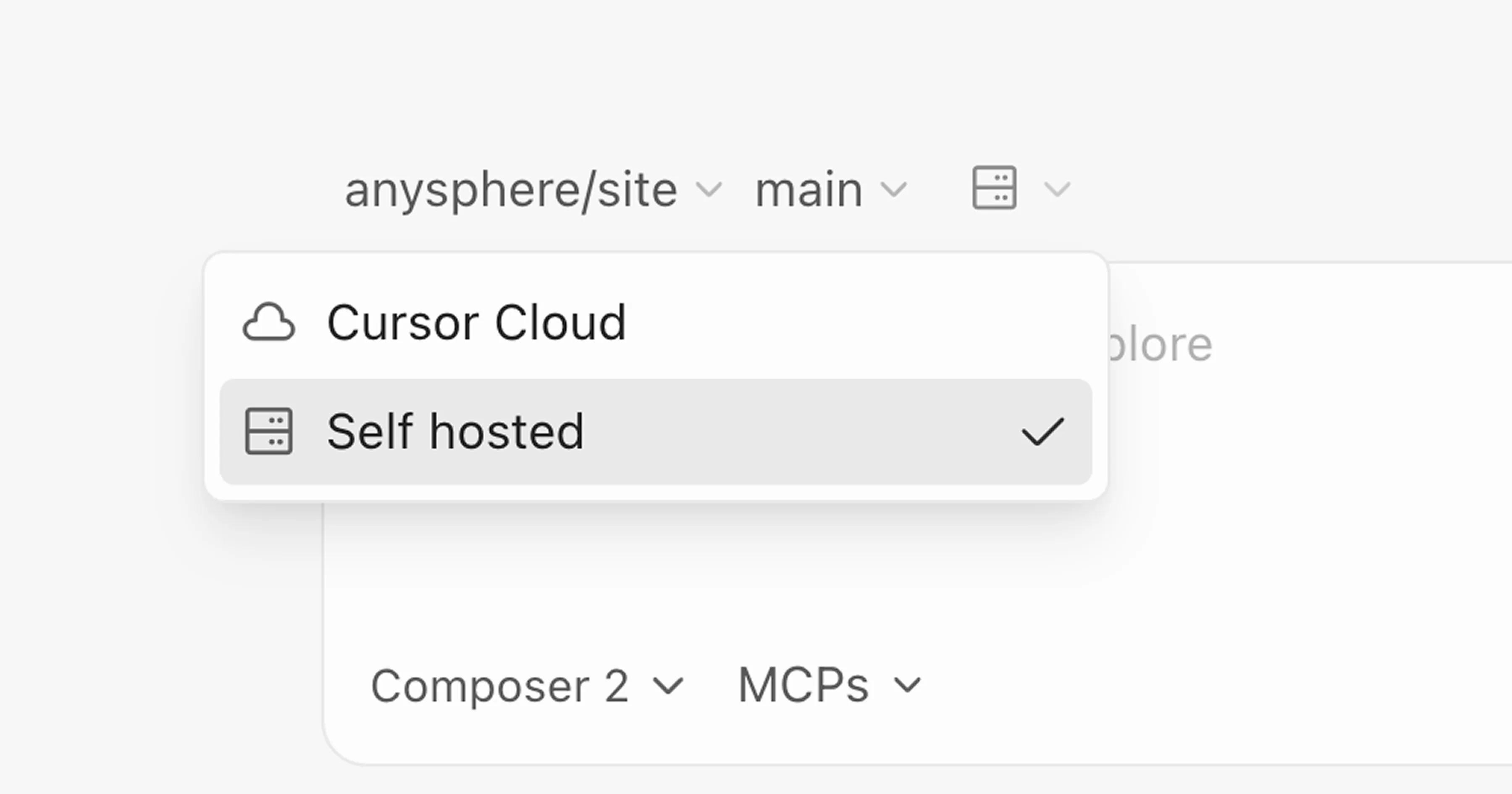
This climate is accelerating the move to self-hosted cloud agents: agents that run in isolated, enterprise-controlled environments, with all code execution, data access, and tool integration happening on infrastructure you control.
Self-Hosted Cloud Agents: Same Power, Superior Control
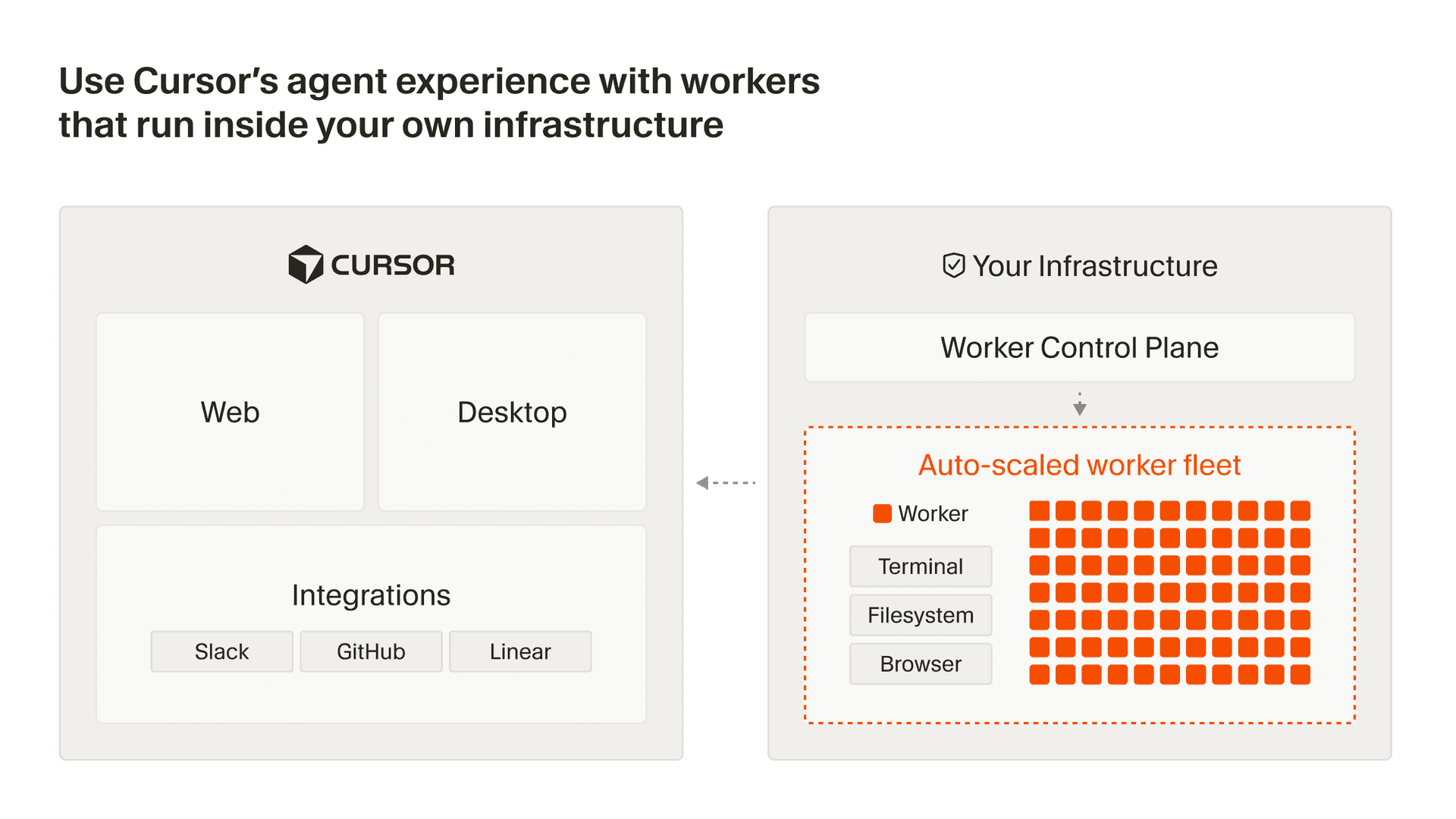
Unlike traditional public cloud agents, self-hosted cloud agents deliver the same developer experience and automation capability without sacrificing security or compliance. Each agent operates in a dedicated virtual machine—with its own desktop, browser, and terminal—mirroring the tools and network reach of a real engineer, but never letting sensitive code or artifacts leave your environment.
Take the example of Brex: with nearly 1,000 engineers, they’ve architected workflows where agents can create pull requests directly from Slack, all without exposing source code to external clouds. Money Forward, another financial services leader, is leveraging self-hosted agents to maintain their strict security regimes while still deploying large-scale automation. As Ben Kraft, Software Engineer at Notion, explained, running agents in their own cloud allows Notion’s massive codebase to be handled securely—without the operational drag of managing multiple stacks.
- Isolated remote environments for each agent—no resource sharing, ensuring strong parallelization and blast radius containment.
- Team permissions and granular access controls anchor agents firmly in enterprise security models.
- Extensibility: plugin support, multi-model harnesses, and remote desktop takeover for hands-on debugging and automation.
This model is a meaningful step toward making agentic AI truly enterprise-ready: blending the agility of cloud-native automation with the control demanded by modern compliance standards. As Google Cloud (2026) notes, AI integration is now a top priority across hybrid and self-hosted deployments, not just public cloud.
How Self-Hosted Cloud Agents Actually Work at Scale
It’s one thing to run a single agent securely. It’s another to orchestrate thousands of agents across a global enterprise without breaking a sweat. This is where modern orchestration and fleet management come into play.
Self-hosted agent frameworks typically use a worker process that initiates outbound HTTPS connections to a central orchestration service—meaning no inbound firewall changes or VPN tunnels are required. When a developer or automation kicks off an agent session, the orchestration layer handles model inference and planning, then dispatches tool calls to the worker running inside your infrastructure. Execution results flow back for iterative planning and review. This architecture allows:
- Support for long-lived or ephemeral agents, adapting to both persistent workloads and short-lived tasks.
- Seamless integration into Kubernetes or any cloud environment via Helm charts, custom operators, or fleet management APIs.
- Enterprise-scale deployments with rolling updates, lifecycle management, and real-time utilization monitoring.
For organizations running hybrid or multi-cloud environments, this approach aligns perfectly with the ongoing surge in hybrid cloud adoption. According to Databank (2026), hybrid strategies are rapidly overcoming traditional barriers, enabling businesses to combine the best of both worlds: public cloud agility and private cloud security.
Security, Compliance, and the Future of Agentic Automation
Security remains the number one inhibitor—and motivator—for self-hosted agent adoption. As IBM X-Force (2025) reports, threat actors are increasingly targeting not just cloud infrastructure, but the intricate workflows and dependencies of AI-powered systems. Self-hosted agents address this head-on by ensuring:
- Code, data, and credentials never leave trusted environments.
- Access to internal caches, dependencies, and specialized network endpoints—critical for complex enterprise builds.
- Regulatory compliance for industries where data residency and auditability are non-negotiable.
But self-hosted doesn’t mean isolated. Modern solutions let organizations tap into powerful orchestration, AI models, and agent frameworks without surrendering operational sovereignty. As June Yang, VP of Cloud AI at Google Cloud, succinctly put it:
Agentic AI will transform business processes, but organizations must address new risks and operational challenges. — Google Cloud, 2026
Forward-thinking enterprises are recognizing that self-hosted cloud agents aren’t a step backward—they’re an evolution, allowing AI and automation to scale with confidence.
What Tech Leaders Should Do Now
Transitioning to self-hosted cloud agents isn’t just a technical migration—it’s a strategic move. Tech leaders should assess:
- Current cloud security posture: Are you comfortable with external agent execution, or do you need absolute control?
- Regulatory environment: Do compliance needs dictate where and how agents run?
- Automation roadmap: Which workflows would benefit most from agentic automation if security and integration hurdles were removed?
- Operational readiness: Do you have the infrastructure and expertise to support large-scale self-hosted agents, or would a partner accelerate your journey?
As the Forrester 2025 cloud trends highlight, AI and multicloud adoption will dominate strategy—but only with mature cost management and risk controls. Partnering with experienced engineering teams, like those at Jina Code Systems, can help enterprises design, deploy, and scale secure agentic infrastructures tailored to their unique needs.
Conclusion
Self-hosted cloud agents are more than a security fix—they’re the foundation for a new era of intelligent, compliant, and resilient automation. As hybrid and multi-cloud strategies become the enterprise norm, organizations that master this architecture will outpace competitors on both innovation and operational trust. At Jina Code Systems, we help businesses design and build AI-powered platforms—whether in your cloud, on-premises, or hybrid environments. Ready to future-proof your automation strategy? Explore our latest insights or reach out to see how we can accelerate your secure agent adoption.