In the rapidly evolving landscape of AI and automation, the concept of intelligent delegation is emerging as a pivotal factor in how businesses manage tasks. As AI systems grow more sophisticated, understanding the nuances of task delegation becomes crucial for effectively leveraging these technologies. This blog post delves into the various aspects of AI delegation, examining its significance in modern enterprises.

Understanding the Complex Landscape of Task Delegation
Delegation in AI can be dissected into several critical aspects, each influencing how tasks are managed across digital systems. These include:
- Complexity: The inherent difficulty of a task, often linked to its sophistication and required reasoning.
- Criticality: The importance of a task and the impact of its failure.
- Uncertainty: The ambiguity in task environments and outcomes.
According to McKinsey, AI has the potential to automate 30% of tasks in 70% of occupations, highlighting the need for effective delegation strategies.
These axes help contextualize tasks for AI, enabling more precise and effective delegation strategies.
The Role of AI Delegation in Enterprise Operations
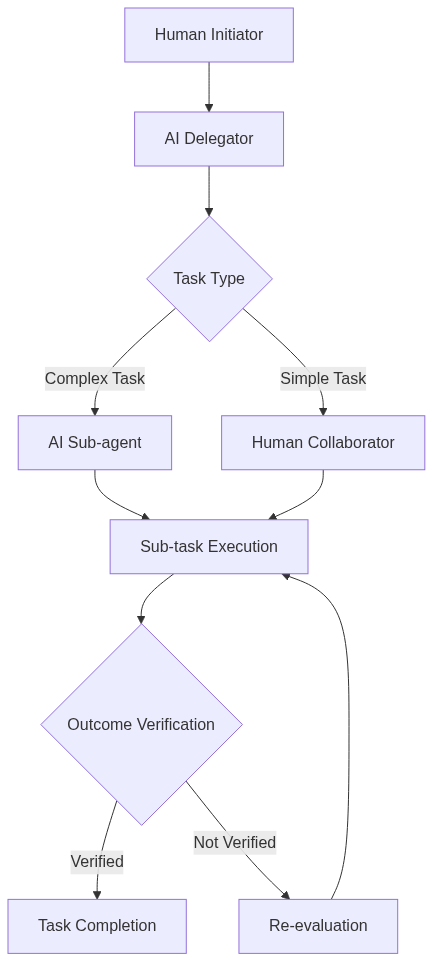
As enterprises increasingly adopt AI, the dynamics of task delegation evolve. AI can delegate tasks to both human and other AI agents, creating a network of collaborative systems. This shift is supported by:
- Granularity: Tasks can be broken down into finer objectives, allowing specialized agents to handle specific sub-tasks.
- Autonomy: AI systems often have the autonomy to pursue sub-tasks independently, enhancing efficiency.
A Gartner report predicts that by 2025, AI will drive a 10% increase in productivity by optimizing task delegation and execution.
Understanding these roles and their implications can significantly enhance operational efficiency in businesses.

Human-AI Collaboration: Challenges and Opportunities
AI-human delegation presents unique challenges and opportunities. While AI can enhance productivity, it also raises concerns about job quality and worker stress. To address these, businesses must:
- Ensure trust calibration between humans and AI, aligning expectations and capabilities.
- Implement effective monitoring systems to ensure task quality and compliance.
A study by Forrester found that 40% of companies report improved decision-making processes through AI-human collaboration.
Balancing these elements can create a harmonious and productive work environment.
Designing AI Delegation Frameworks in Organizations
To successfully integrate AI delegation, organizations must develop robust frameworks that consider:
- Span of Control: Determining the optimal number of AI agents per human overseer to maintain efficiency without sacrificing oversight.
- Authority Gradient: Addressing communication gaps that can lead to errors in task execution.
Research from the Harvard Business Review highlights that effective delegation frameworks can reduce operational costs by up to 15%.
Such frameworks ensure that AI delegation aligns with organizational goals and enhances overall performance.
Future Implications of AI Delegation
As AI continues to evolve, its role in task delegation will expand, impacting industries globally. The future of AI delegation includes:
- Greater integration of dynamic cognitive friction to improve decision-making in ambiguous situations.
- Enhanced trust calibration techniques to align AI capabilities with human expectations.
A report from Accenture suggests that AI delegation could boost global productivity by up to 40% by 2035 through enhanced task management and efficiency.
These advancements promise to redefine how businesses operate and compete on a global scale.
Conclusion
AI delegation is more than a technological advancement; it's a strategic tool for modern enterprises. By understanding and leveraging the complexities of task delegation, businesses can unlock new levels of efficiency and innovation. At Jina Code Systems, we specialize in designing and building intelligent digital systems that harness the power of AI delegation to drive business success. As the landscape continues to evolve, partnering with experts who understand these dynamics will be crucial for staying ahead.